Infographic – Access to a healthy diet unaffordable for more than one out of three people due to constantly rising costs
The affordability of a healthy diet is assessed through two complementary indicators: the minimum cost of a healthy diet and the proportion of people who cannot afford to eat healthily (see box). Since 2017, the cost of a healthy diet has been rising steadily, increasing by more than 40% over the past seven years. France and Europe consistently record figures below the global average, but are following the same upward trend.
The proportion of people who cannot afford to eat healthily has fallen on average, but remains above that of 30% of the global population. This generalised improvement is largely driven by the post-COVID-19 economic recovery, as well as by significant progress in Asia, especially in India, where updated household consumption data have led to a substantial downward revision of global estimates. Here too, France and Europe’s rates are significantly below the global average. Nevertheless, France has seen the proportion of people unable to afford a healthy diet rise between 2017 and 2024, whereas this indicator has generally tended to fall across Europe.
However, the improvement in global access to a healthy diet masks marked regional disparities and differences between income groups. In low-income and lower-middle-income countries (excluding India), the number of people unable to afford a healthy diet has been rising steadily since 2017 (FAO, 2025).
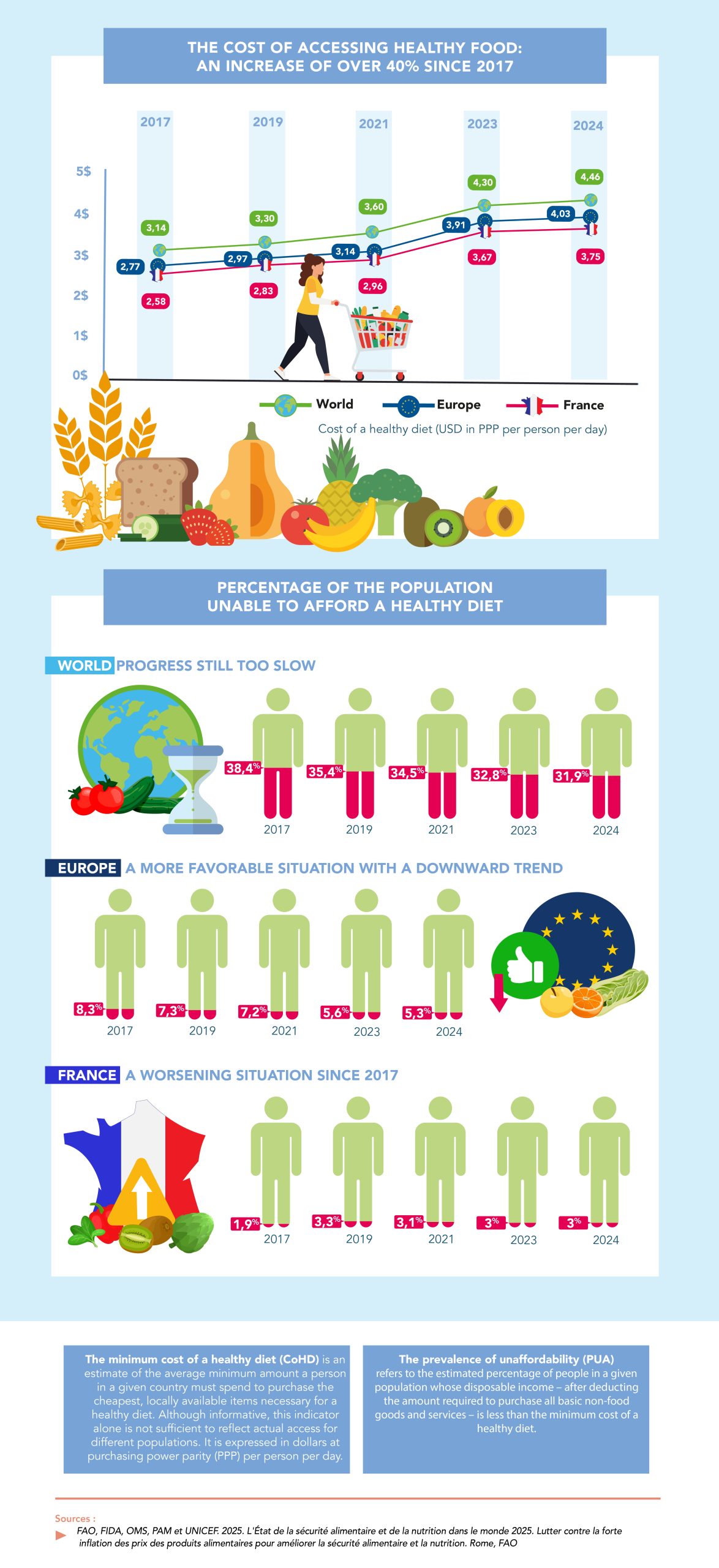
The minimum cost of a healthy diet (CoHD) is an estimate of the average minimum amount a person in a given country must spend to purchase the cheapest, locally available items necessary for a healthy diet. Although informative, this indicator alone is not sufficient to reflect actual access for different populations. It is expressed in dollars at purchasing power parity (PPP) per person per day.
The prevalence of unaffordability (PUA) refers to the estimated percentage of people in a given population whose disposable income – after deducting the amount required to purchase all basic non-food goods and services – is less than the minimum cost of a healthy diet.