Infographic – Motivational interviewing: a lever for supporting changes in health behavior
Healthcare professionals play a central role in nutritional prevention, supporting patients to make healthier food choices. However, changing behavior in a real and lasting way can be challenging, especially when dealing with patients’ ambivalence and willingness to commit.
To support their action, practitioners can rely on different resources and approaches, such as motivational interviewing. This tool has been shown to be particularly effective in supporting patients to stop smoking.
Based on a collaborative, individual-centered approach, motivational interviewing helps patients explore their own motivations and build confidence in their ability to change. The practitioner adopts an empathetic, caring posture, rather than imposing directives, facilitating an open, personalized discussion.
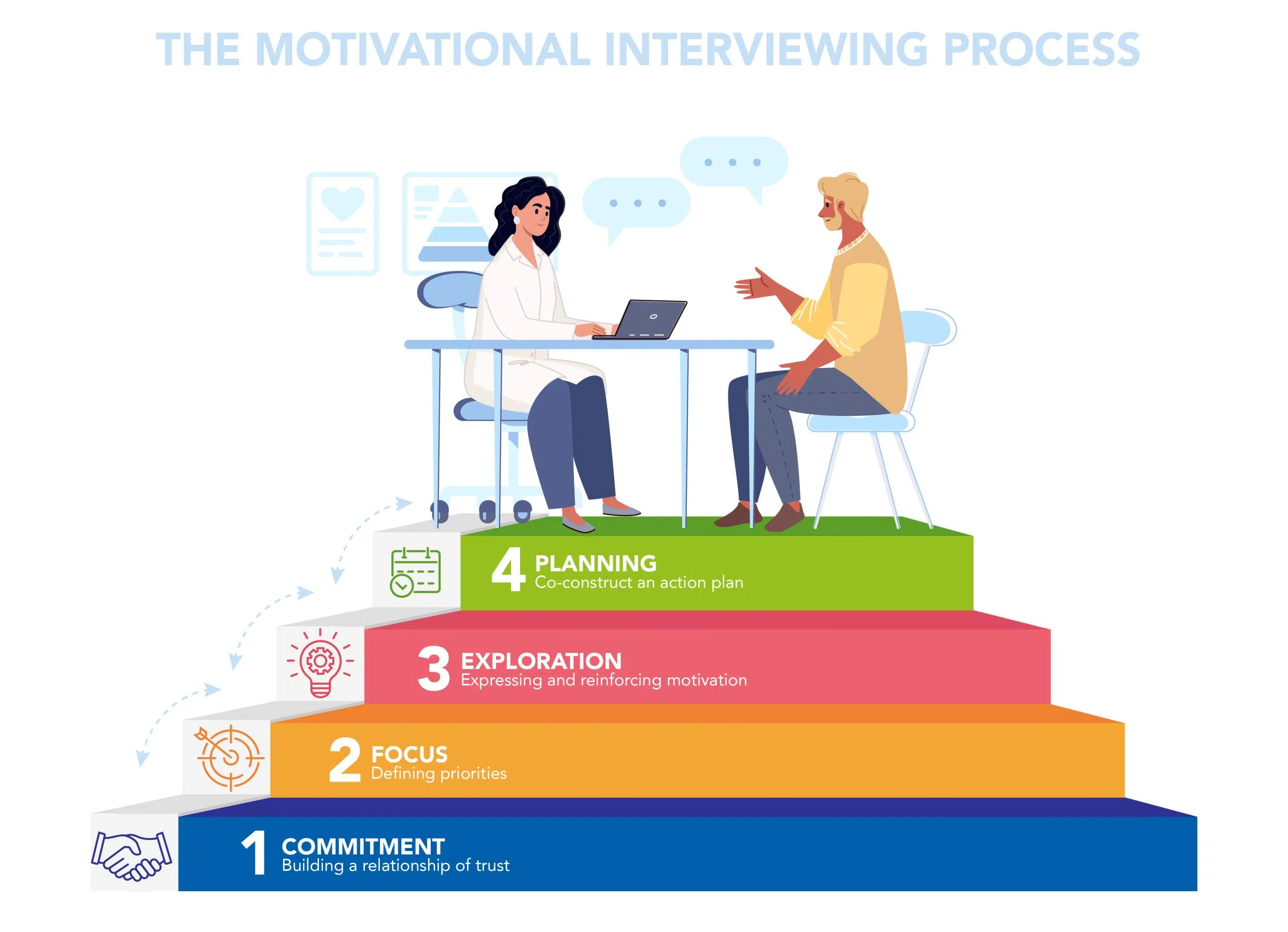
This approach is based on four successive, interconnected processes, depicted as steps. Each step builds on the previous one, with the ability to go back down temporarily and then go forward again, illustrating the flexibility and adaptability needed to support change.
- Commitment: building a relationship of trust and cooperation with the patient, to create a climate conducive to change.
- Focus: clarify and define priorities, ensuring that patient and professional share a common vision of the goals to be achieved.
- Evocation: support the patient in expressing his or her own motivations and reasons for change, exploring ambivalence and reinforcing motivation.
- Planning: co-construct an action plan with the patient, identifying realistic goals and strategies for overcoming future obstacles.