Cancer remains the second leading cause of death worldwide, despite medical advances and prevention efforts. Almost 40% of cases are linked to modifiable factors and could therefore be prevented. To this end, World Cancer Research Fund (WCRF) regularly assesses knowledge of food-related risk and protective factors. This work provides a basis for prevention recommendations, which generally focus on risk/protective factors taken in isolation. In its latest report, published in spring 2025, WCRF adopts a broader perspective, calling for a holistic approach to all dietary habits and health-related behaviours. This report places the adoption of a healthy diet, rich in fruit and vegetables, at the heart of lifestyle habits that protect against cancer.
From 1990 to 2023, the number of new cancer cases (see box) more than doubled. This trend, which is associated in particular with the ageing of the global population, is expected to continue, with a forecasted increase of nearly 60% in the number of new cancer cases by 2025 (GBD 2023 Cancer Collaborators, 2025). This situation, which is particularly affecting low- and middle-income countries, requires the implementation of major structural measures intended to improve the prevention, diagnosis and treatment of this group of diseases.
In fact, almost 40% of cancer cases are linked to modifiable lifestyle factors such as alcohol consumption, tobacco use, UV exposure, diet (insufficient/excessive intake of certain nutrients or foods), physical inactivity, and being overweight (WHO, 2025). To date, most prevention strategies remain focused on addressing these factors in isolation. They do not consider the interactions between them, nor between health behaviours.
To take this complexity into account and align more closely with the population’s actual lifestyle patterns, research is now moving towards a more holistic approach, seeking to identify the influence of lifestyle habits as a whole on the risk of cancer. In this context, the latest WCRF report provides an updated overview of the effects of dietary and lifestyle patterns on cancer risk. This report also identifies barriers to adopting healthy practices and proposes practical ways of improving food environments.
Healthy diet, active lifestyle, healthy body weight and avoiding smoking: four pillars for cancer prevention
One of the key messages of the report is the need for an integrated approach to cancer prevention. Rather than targeting a specific food or nutrient, the new WCRF recommendations emphasise the importance of a healthy overall lifestyle. They underline that a combination of health-promoting behaviours provides a robust foundation for preventing several types of cancer.
The report focuses in particular on breast and colorectal cancer, which are the most common types of cancer after lung cancer and those for which the literature is the most abundant and robust (Konieczna et al., 2025; Chu et al., 2025).
Breast and colorectal cancer respectively accounted for 12% and 10% of new cancer cases in 2022 (Sung et al., 2021; WHO, 2023).
According to this report, lifestyle patterns associated with a reduced risk of cancer are based on four key behaviours:
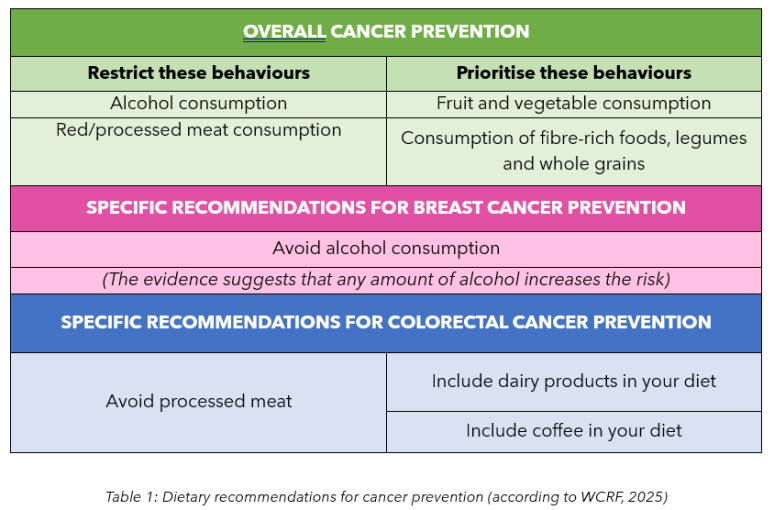
- Adopting a healthy diet: prioritising the consumption of fruit, vegetables and fibre-rich foods, and limiting red meat and processed meat;
- Regularly engaging in physical activity;
- Maintaining a “healthy” body weight;
- Not smoking.
In addition to these general recommendations, there are specific recommendations for breast cancer (avoiding alcohol consumption) and colorectal cancer (avoiding processed meat and including dairy products and coffee in your diet).
These recommendations remain closely aligned with those issued in 2018, demonstrating that the earlier recommendations serve as an integrated model. This perspective implies the need to address several levers simultaneously. Therefore, the report emphasises that adopting health-promoting behaviours should be viewed as a sustainable, long-term process that must be consistently integrated into lifestyle patterns.
Cancer prevention: adapting the recommendations to cultural and local contexts and modifying environments
The new WCRF report calls for the revision of public health policies to promote dietary recommendations tailored to cultural and local contexts, rather than uniform and restrictive guidelines. It stresses the importance of linking nutrition and climate issues in order to build more sustainable food systems. The report also highlights the need to enhance the scientific quality of studies and develop standardised assessment tools, while better representing different populations, particularly in Africa and Latin America.
In addition to updating the recommendations, WCRF analyses the barriers that limit the adoption of behaviours conducive to cancer prevention. It shows that while individual barriers (lack of time, motivation) are well known, structural factors – insecurity, lack of infrastructure, socio-economic inequalities and cultural norms – play a major role. Ensuring safe access to public spaces for all, encouraging fruit and vegetable consumption and improving educational programmes therefore seem essential. Lastly, the report points out that adopting a healthy lifestyle is not solely a matter of personal choice, but also depends on collective determinants that need to be addressed by policy makers.
Cancer is characterised by the rapid multiplication of abnormal cells that grow uncontrollably, ultimately disrupting bodily function. The development of cancer is multifactorial and is the result of external factors related to the environment (radiation, viruses, industrial products, etc.) or lifestyle (tobacco, alcohol, diet, lack of physical activity, and so on), as well as internal factors specific to each individual (ageing or genetic predisposition). Therefore, no single food or component can prevent the development of cancer.
World Cancer Research Fund (WCRF) International is a non-governmental organisation that leads and unifies a network of cancer prevention charities: the American Institute for Cancer Research (AICR), World Cancer Research Fund in the United Kingdom, Wereld Kanker Onderzoek Fonds in the Netherlands and World Cancer Research Fund Hong Kong. WCRF champions the latest and most authoritative scientific research from around the world on cancer prevention and survival through diet and physical activity. The results of WCRF’s research are used to produce evidence-based cancer prevention recommendations that help save lives around the world.